Highlights of 1st press-conference: Rolls Royce and others
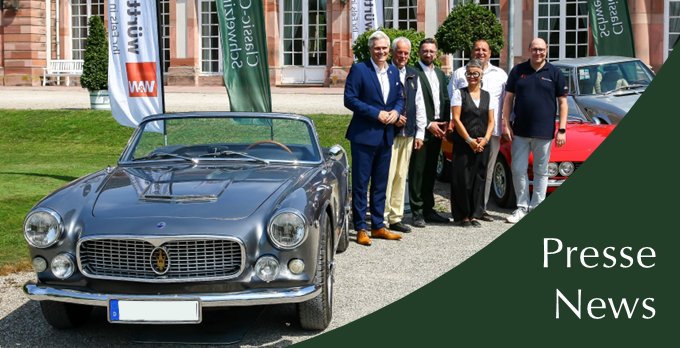
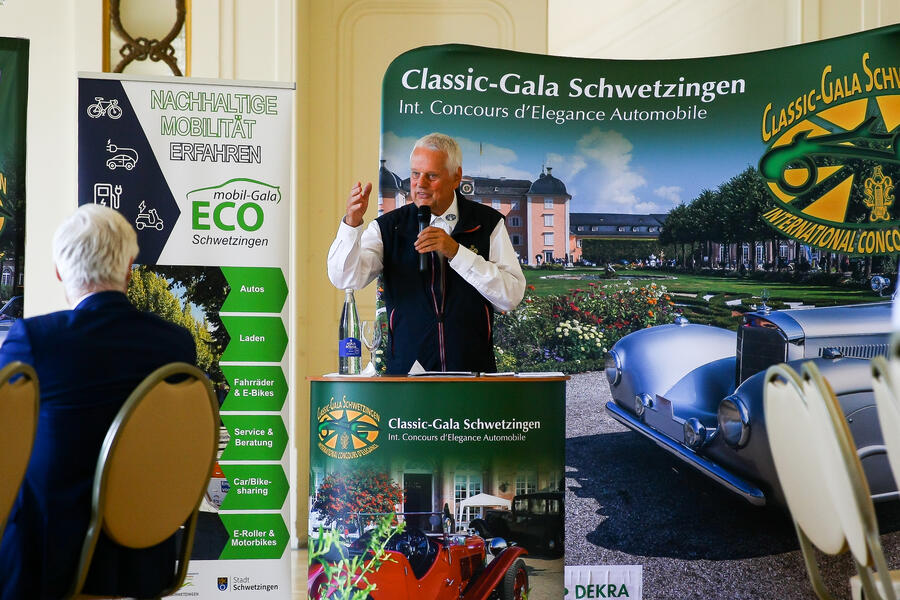
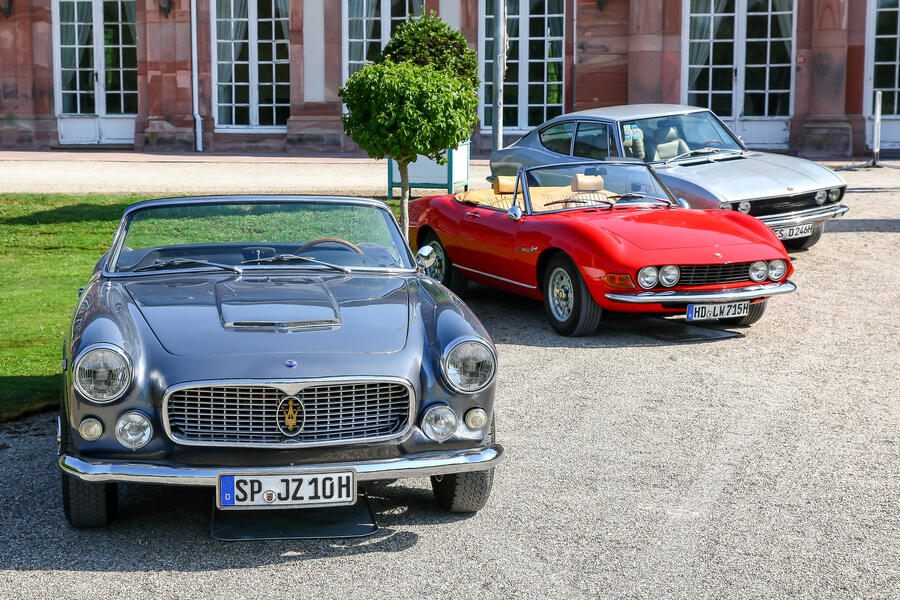
The highlights and information about the programme were published at the first press conference of Classic-Gala Schwetzingen on 9th of July 2024. Selected exhibits like one Rolls Royce Phantom II, a Messerschmidt and the Sam Foose Pantera gave an inpression of the main topics of Classic-Gala Schwetzingen 2024. Please contact us if you like to get the below detailled press-information in english.
Automotive Lifestyle, Culture, Art and Special Anniversary Exhibitions
100 Years Maserati Automobile - 90 Years BMW 328 - Passione Dino - Sunbeam Venezia
From 28 to 30 August 2026, the magnificent Palace Gardens of Schwetzingen, near Heidelberg, will once again become the meeting place for 160 of the finest classic automobiles from the past 125 years. The ASC Classic-Gala Schwetzingen is Germany's longest-established international Concours d'Elegance held in a palace garden and is organized, as always, in accordance with FIVA regulations.
What began in 2001 as the first European Concours d'Elegance has evolved into an internationally acclaimed automotive concours with a worldwide reputation.
A Unique Journey Through Automotive History
From steam-powered vehicles and electric cars to early motor carriages, post-war microcars, state limousines and ingenious one-off creations, CLASSIC-GALA SCHWETZINGEN 2026 illustrates the evolution of the automobile while demonstrating that outstanding design has always been one of its defining characteristics.
With a family-friendly admission price of just €9 (plus a €2 service fee), this exceptional event is open to everyone, offering a rare opportunity to experience automotive excellence in one of Europe's most beautiful palace gardens.
An international jury honours the most beautiful and rare automobiles, while visitors enjoy an elegant atmosphere, strolling through the park and admiring extraordinary vehicles. The ASC Classic-Gala Schwetzingen is far more than a competition—it is a social and cultural event that brings together automotive heritage, art and lifestyle. Recognised by The Concours Year as "One of the Greatest Concours," the event continues to set international standards for automotive concours.
Within the circular Baroque gardens, spanning more than 300 metres in diameter, carefully selected exhibitors present automobilia, period clothing, books, model cars and exclusive accessories. Live jazz by "4 to the Bar" provides the soundtrack, while culinary islands throughout the park invite visitors to relax and indulge. In the South Wing, renowned artists exhibit automotive-inspired works of art, accompanied by live piano music.
The US Car Concours, surrounded by magnificent American classic cruisers, features lively square dance performances, live Elvis tribute shows, authentic barbecue and classic American burgers.
The Classic-Gala Schwetzingen offers a truly unique opportunity to stroll, relax and experience automotive history at leisure. In 2025, the event welcomed more than 28,000 enthusiastic visitors.
Anniversary Celebrations and Special Features
The 2026 edition once again presents significant anniversaries, special exhibitions and outstanding automotive highlights that make Schwetzingen an incomparable event.
100 Years of Maserati – Elegance, Speed and Motorsport
In 1926, brothers Alfieri, Bindo, Ernesto and Ettore Maserati completed their first automobile, the ambitious Tipo 26, powered by an advanced straight-eight engine. What had begun as a manufacturer of spark plugs and automotive electrical components evolved into a true automobile company.
The Tipo 26 became Maserati's first genuine racing car and immediately claimed victory in its class (up to 1,500 cc) at the legendary Targa Florio in Sicily.
To celebrate the 100th anniversary of Maserati automobiles, the ASC Classic-Gala Schwetzingen, in partnership with Maserati Germany, will showcase the marque's most significant models bearing the iconic Trident emblem. Visitors will also have the opportunity to test-drive the latest Maserati models.
The Golden Age of Grand Prix Racing
During the 1930s, Maserati established itself as one of Europe's leading racing car manufacturers. As early as 1929, the company astonished the motorsport world with the Tipo V4, powered by an extraordinary 4-litre V16 engine. Even more legendary was the 3-litre Maserati 8CTF, which dominated international racing at the end of the decade.
Competing against marques such as Alfa Romeo, Bugatti, Mercedes-Benz and Auto Union, Maserati quickly became a formidable rival. Unsurprisingly, demand grew for road-going Maseratis, and the elegant A6 models bodied by Ghia, Pininfarina, Touring, Vignale and Zagato laid the foundations of the Italian Gran Turismo tradition.
From the Racetrack to the Open Road
The ASC Classic-Gala will present iconic Maserati racing cars such as the 4CLT Monoposto and the 8 CM, alongside the beginning of Maserati's grand touring production with the celebrated 3500 GT.
Until 1964, the elegant Touring Coupés and Vignale Spider combined the six-cylinder racing engine technology derived from the legendary 250 F Formula One car with genuine everyday usability, attracting customers from around the world.
The 3500 GT was followed in 1963 by three remarkable new models: the beautifully styled Sebring by Vignale, the similarly powered but futuristic Mistral with coachwork by Frua, and the unique Quattroporte, instantly recognised as the fastest production luxury saloon in the world.
These models firmly established Maserati as a competitor to Ferrari, Jaguar and Aston Martin. When the Ghibli, designed by Giorgetto Giugiaro at Ghia, entered the exclusive 280 km/h performance league in 1967, it effectively relegated Ferrari to second place until the arrival of the Daytona. The Maserati Indy, introduced in 1969 as a classic 2+2 grand tourer, found 1,136 owners by the end of production in 1975.
Many of these iconic Maseratis will be displayed on the palace terrace at Schwetzingen.
Maserati and Citroën
In 1968, Citroën acquired a controlling interest in Maserati, introducing innovative technology and entirely new engine concepts.
The Maserati Bora, launched in 1971, became Maserati's first mid-engined supercar. It was followed in 1972 by the Merak, featuring an almost identical body but powered by a 3.0-litre V6 engine and incorporating numerous Citroën mechanical components.
Replacing the Ghibli, whose production ended in 1973, the wedge-shaped Khamsin was introduced in 1974. Featuring Giorgetto Giugiaro's avant-garde styling, a distinctive glass rear panel and a powerful 360 hp 5.0-litre V8, it was one of the most striking grand tourers of its era. Despite its innovative design, only 421 examples were sold over eight years, making the Khamsin a true automotive rarity—one that visitors can admire in Schwetzingen.
In 1975, South American industrialist Alejandro de Tomaso acquired Maserati. His era introduced the sharply styled Kyalami (1977) and the Quattroporte III, embracing the angular design language of the 1970s that proved especially successful for the Quattroporte.
Turbocharged Performance
The Maserati Biturbo, launched in 1981, was a compact luxury coupé featuring twin-turbocharging. Initially powered by a 2.0-litre engine to avoid Italy's higher luxury tax bracket, the range was later expanded with a 2.5-litre V6 Spider, followed in 1988 by a 2.8-litre V6 producing 250 hp and a top speed of 230 km/h.
Technically groundbreaking yet comparatively affordable for a Maserati, the Biturbo opened the brand to a broader audience. The Biturbo family—including more than half a dozen derivatives such as the Karif, Shamal and Ghibli II—will be represented at the ASC Classic-Gala.
Maserati's Renaissance under Ferrari
FIAT acquired Maserati in 1993, before transferring control to Ferrari, which ushered in a new era with the elegant Quattroporte IV, styled by legendary designer Marcello Gandini.
Maserati's return as a leading high-performance marque began in 1998 with the launch of the 3200 GT, instantly recognisable by its iconic boomerang-shaped rear lights and powered by a 368 hp 3.2-litre V8. From 2001, the range expanded with a 4.2-litre V8 and the Spyder, while the Quattroporte V, introduced in 2004, revived Maserati's tradition of building world-class luxury saloons.
Although Ferrari engineering remained largely hidden beneath the bodywork, it became unmistakable in the spectacular Maserati MC12 of 2004. Technically derived from the Ferrari Enzo, this limited-production supercar became a motorsport legend, returning Maserati to the forefront of international GT racing with multiple FIA GT Championship victories.
The Italdesign-styled Quattroporte remains one of the world's most charismatic luxury saloons, while the Maserati GranTurismo, introduced as the successor to the GranSport in 2005, achieved worldwide acclaim for its timeless styling and unmistakable V8 soundtrack. Many milestones from this remarkable chapter of Maserati history will be on display in Schwetzingen.
Maserati has long been the marque of artists, aristocrats and legendary racing drivers such as Juan Manuel Fangio, Stirling Moss, Carroll Shelby and Lucky Casner. Its distinguished owners have also included Frank Sinatra, Peter Sellers, Marcello Mastroianni and Jay Kay. Combining exclusivity with understated elegance, Maserati has always been less ostentatious than Ferrari, yet equally emotional. At the ASC Classic-Gala Schwetzingen, visitors can experience Maserati as one of the defining icons of Italian automotive culture.
Passione Dino – Together for the First Time
In cooperation with the Dino Interest Group (Dino IG), the Classic-Gala Schwetzingen presents the most important variants of every automobile bearing the Dino name. Although the three model lines fulfilled different roles, they are closely connected both technically and historically. Their common denominator was the V6 engine inspired by the work of Alfredo "Dino" Ferrari, Enzo Ferrari's son.
Introduced in 1967, the Dino 206 GT was the first production sports car of the Dino family. It featured a 2.0-litre aluminium V6 producing around 180 hp, an aluminium body and a comparatively limited production run.
Deliberately, it carried only the Dino badge rather than the Ferrari name, as Enzo Ferrari intended the V6-powered cars to appeal to a new generation of customers.
The Dino 246 GT, launched in 1969, featured a 2.4-litre cast-iron V6 producing 195 hp. Its steel body (with selected aluminium panels) made it more practical for everyday driving, while substantially higher production numbers reflected its commercial success.
The FIAT Dino, introduced from 1966, took a different approach. Available as a Bertone Coupé and Pininfarina Spider, it featured a front-mounted engine and was created primarily to satisfy motorsport homologation requirements.
Under the FIA's Group 4 regulations, Ferrari was required to produce a minimum number of V6 engines for road cars before using the engine in competition. Ferrari alone lacked the production capacity, so an agreement was reached with FIAT, which manufactured the V6 engines and installed them in its own production models. Although the engines were closely related, the FIA recognised that the Ferrari's engine was mounted behind the driver while the FIAT Dino used a conventional front-engine layout, meaning the Dino 206 still qualified as a prototype despite Ferrari's ingenious solution.
Although they shared the same engineering heritage, the cars possessed distinctly different characters. The 2.4-litre V6 in the FIAT Dino and the Dino 246 GT was tuned specifically for their individual purposes: the Ferrari Dino focused uncompromisingly on sporting performance, while the FIAT Dino prioritised refinement, comfort and long-distance touring.
The Passione Dino display, located beside the Hirschbrunnen fountain, will feature an original Dino 206 S hill-climb racing car, every major Dino and FIAT Dino variant, together with the Dino 308 GTB and the legendary Lancia Stratos, which also employed the Dino V6 in a mid-engine configuration.
90 Years of a Winner – The Story of the BMW 328
The sporting success of the legendary BMW 328 shaped the identity of an entire brand. Without it, BMW would almost certainly never have become synonymous with sporting driving.
Almost immediately after the open two-seater made its public debut in 1936, its long bonnet, low-slung profile, cut-down doors and sweeping wings fulfilled their promise of speed. Driven by reigning motorcycle world champion and BMW factory driver Ernst Henne, the BMW 328 won the prestigious Eifel Race at the Nürburgring, instantly capturing the attention of the motorsport world.
The BMW 328 owed its success to the intelligent combination of low weight, aerodynamics, perfect balance and advanced engine technology. Its inline six-cylinder engine, displacing just under two litres, was derived from BMW's 1.9-litre Type 319. However, for the new 1,971 cc engine BMW developed an innovative cylinder head featuring hemispherical combustion chambers and overhead valves—highly advanced engineering for its day.
With 80 hp propelling a weight of just 830 kilograms, the BMW 328 reached a top speed of around 150 km/h. In 1936, this was enough to outperform many significantly larger and more powerful cars over long distances. Lightweight construction, a rigid tubular frame, centre-lock wheels and an exceptionally well-balanced chassis gave the 328 remarkably precise handling, abundant torque and forgiving driving characteristics. Between 1936 and 1941, the 464 examples produced achieved more than 350 race victories in the hands of private entrants, making the BMW 328 the most successful production sports car in motorsport history.
In 1940, the pairing of Fritz Huschke von Hanstein and Walter Bäumer won their class in the shortened Mille Miglia aboard the BMW 328 MM Roadster, recording a remarkable average speed of almost 167 km/h—on public roads, no less. The achievement firmly established BMW's international reputation.
The BMW 328 attracted an extraordinary generation of drivers. Alongside Ernst Henne, one of the first stars of BMW's factory racing team, personalities such as Huschke von Hanstein—later Porsche's Head of Motorsport—joined noblemen and accomplished racing drivers including Alex von Falkenhausen, Richard von Frankenberg, Walter Bäumer and Rudolf Schleicher, who combined engineering talent with racing success.
Even after the Second World War, the BMW 328 engine continued to evolve. It became the basis for numerous racing cars, including the AFM, the Veritas developed by Ernst Loof, a wide range of single-seaters, and British sports cars produced by manufacturers such as Frazer Nash and Bristol. BMW itself continued to use the engine in the 501 "Baroque Angel", ensuring that the 328's remarkable engineering legacy lived on well into the post-war era.
The special exhibition in Schwetzingen will feature the original BMW 328 alongside a unique coupé, the legendary Werkmeister BMW competition car and, among other highlights, the rare BMW 327/28 Cabriolet fitted with the renowned racing engine.
Sunbeam Venezia – A British Gentleman in an Italian Tailored Suit
Presented in 1963, the Sunbeam Venezia ranks among the rarest and most elegant automobiles produced by Britain's Rootes Group. Combining proven British engineering with exquisite Italian coachbuilding, it was created in cooperation with the renowned Carrozzeria Touring of Milan, reflecting Sunbeam's reputation for producing distinctive and stylish automobiles.
The Venezia was based on the Sunbeam Alpine sports car platform with a 218 cm wheelbase. Its name was chosen because the car made its public debut in Venice, where it was spectacularly presented in St Mark's Square after being transported there by gondola.
Although production was originally planned at around 300 cars, only approximately 145 to 200 examples were ultimately completed before the project was discontinued due to limited demand and the financial difficulties of Carrozzeria Touring.
Unfortunately, the Venezia was considerably more expensive than technically similar Rootes models and rival cars, while its performance did not fully justify its premium price. Nicknamed "the Gondola", it also faced stiff competition from sportier GT cars such as the Alfa Romeo GT Junior. For the first time, five of these exceptionally rare grand tourers will be exhibited together at the Classic-Gala Schwetzingen.
Classicbid Charity Auction
For the first time, the renowned classic car auction house Classicbid, based in Grolsheim near Bingen, will conduct a live charity auction of classic automobiles during the Classic-Gala Schwetzingen.
Owners wishing to consign vehicles can still register via www.classicbid.de.
Art Exhibition by C.A.R.
Curated by Curt-Achim Reich (C.A.R.) of Bad Homburg, the accompanying art exhibition once again provides a distinguished forum for automotive-inspired fine art. Alongside works by internationally recognised artists, the exhibition also introduces outstanding new talents. Curt-Achim Reich has recently expanded the exhibition to include masterful paper-cut artworks and contemporary painting. On both event days, visitors are invited to enjoy a special vernissage featuring live music and Bel Canto performances (Saturday at 4:00 pm, Sunday at 2:00 pm).
New Partnerships – Villeroy & Boch World and Victor's Residenz-Hotels
The ASC Classic-Gala Schwetzingen is delighted to welcome Villeroy & Boch World and Victor's Residenz-Hotels as new event partners, making their first joint appearance at the concours.
This collaboration brings together two prestigious brands renowned for quality, hospitality and timeless elegance. Visitors can look forward to inspiring insights into the world of Villeroy & Boch, exclusive offers from Victor's Residenz-Hotels, attractive prize draws and valuable inspiration for their next classic-car tour or short getaway.
As a special distinction, the two overall winners of the 2026 Concours d'Elegance will each receive a limited-edition "La Boule" by Villeroy & Boch.